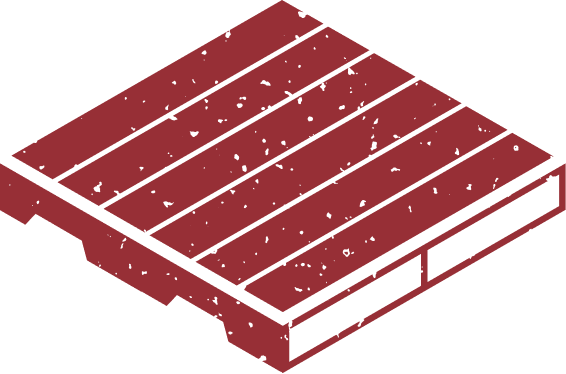
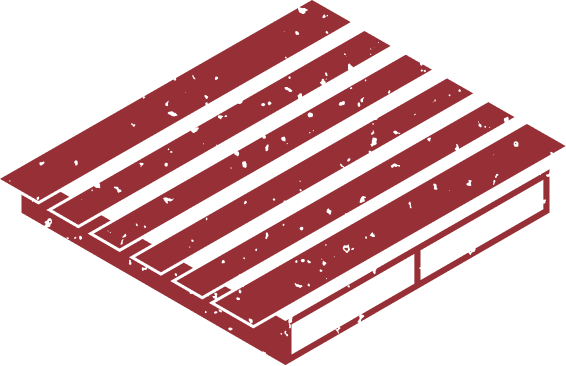
Understanding pallets starts with two simple things: the pallet type, and the pallet grade. Read on to learn exactly what each of these mean! (Looking for a specific answer? Check out the FAQ!)
Pallet Types
We manufacture and recycle a variety of pallets. The main types being: new lumber, recycled lumber, and plastic. Whatever you’re shipping, there’s a pallet made to match — simple, sturdy, and surprisingly varied. See below for more details.
Allows access from 2 sides. Marginally stronger. Recommended for pallets longer than 60″ or for heavy commodities.
Four-Way
Allows access from all sides of the pallet. This feature increases safety, saves time, and maximizes space.
Structure
Lorem ipsum dolor sit amet, consectetur adipiscing elit. Ut elit tellus, luctus nec ullamcorper mattis, pulvinar dapibus leo.
Stringer or Runner
The “stringers” or “runners” refer to the solid lumber beams that runs the length of the pallet (between the deckboards). They are usually 2×4″s.
The benefits of this style are availability, cost efficiency, and sturdiness.
Block Style
Sometimes called the “9-block” pallet, block style pallets offer true four-way entry, making them easy for forklifts and pallet jacks to grab from any side. They’re great for high-traffic, high-efficiency operations where maneuverability matters.
Skid
The simplest form — no bottom deck boards. Lightweight, easy to drag, and ideal for temporary storage, display, or one-way shipping.
Crate
Crates take things a step further with fully enclosed or partially enclosed walls that protect products from shifting, damage, or exposure. They’re the go-to choice for fragile items, export shipments, and anything that needs a little extra protection on the road.
Board Styles
The number and size of deck boards influences the strength, size of the gaps, and overall weight of the pallet.
Two common options:
Standard Spacing
Gaps are typically 3-5″
Solid top
Gaps are ~1″ gaps to allow airflow.
Special Features
Some purposes require the deck boards to either overlap or stop before the edge of the stringer (This is different than the standard, where the deck boards are flush with the stringer on the side profile).
Wings
Easy access with pallet jack (pallets used in big box retail stores)
Recessed
Supposedly better for flex wrapping, banding, and pallet life longevity.
Pallet Grades
We offer several lumber options to suit your needs. Below we explain each grade and why one might choose each type.
New lumber is high quality, customizable, and aesthetically pleasing.
We recommend it when the end-user is sensitive to optics or cleanliness and for large pallets that are uncommon in recycled material.
Softwood
Hardwood
Green or kiln dried
Grade A
Grade A lumber is the higher quality of recycled material. Roughly 20% of all recycled pallets fall into this category, causing a higher price than B’s.
This product is recommended to customers who need a balance of aesthetics and price.
Grade B
Grade B pallets are structurally sound, but have more repairs and can be less attractive.
Recommended for use within your own warehouse or for customers who say, “The forklift doesn’t care if it looks good.”
FAQ
What are typical lead times?
Our mission is to never let our customers run out of pallets, because we know how expensive it is to stop production.
If you’re in a rush, we will bend over backwards to help. If you’re not in a rush, 1-2 days is typical for us.
What types of pallets do you sell?
New pallets
Recycled/used pallets
Custom builds
Heat-treated pallets (ISPM-15 compliant)
Standard 48×40″ pallets
Do you deliver?
Yes, we deliver with our own fleet that has over 200 dry vans, flatbeds, and box trucks. We can live unload, but prefer to drop trailers at your facilities to give you extra space and faster deliveries.